
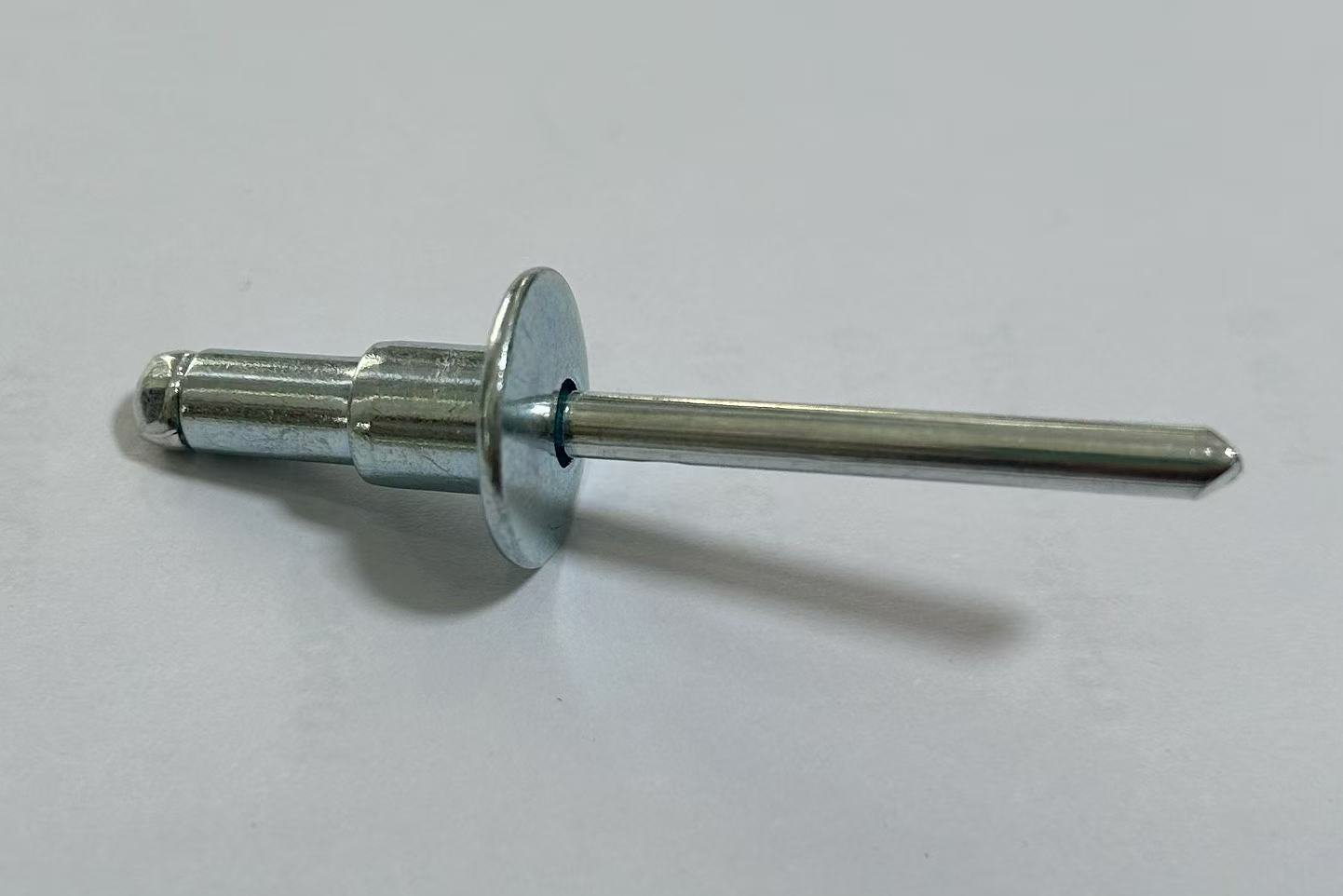
When designing assemblies that demand high structural integrity, moisture sealing, or rotational flexibility between joined components, conventional fasteners often fall short. Enter the Stepped Blind Rivet (also known as a Stepped Body / Step-Tail Blind Rivet)—an innovative mechanical fastener engineered for complex structural joinery.
In this technical guide, we will break down the anatomical structure, installation process, key benefits, and real-world industrial applications of stepped blind rivets.
1. What is a Stepped Blind Rivet?
Unlike standard cylindrical blind rivets, the defining characteristic of a stepped blind rivet is its two-stage or multi-stage stepped rivet body. This unique geometric feature allows for progressive expansion during installation, achieving superior mechanical locking, exceptional sealing capabilities, and even controlled clearance for moving parts.
2. Anatomical Breakdown & Structural Design
The stepped blind rivet system comprises two primary components: the Rivet Body (1) and the Mandrel/Nail Core (2).
A. The Rivet Body (Figure 3)
Main Body (4): The primary tubular section housing the internal hollow bore (6).
Rivet Head (5): Positioned at the upper end of the main body with a diameter larger than the shaft. It features a smooth spherical dome that provides precise positioning during installation, delivers an aesthetically clean surface finish, and eliminates sharp burrs.
Step / Collapsible Section (3): Located at the distal end of the rivet body, this section features a reduced outer diameter compared to the main body (4). A distinct shoulder step is formed at their junction, with rounded fillets applied at transition points to prevent stress concentrations.
B. The Mandrel / Core (Figure 4)
Mandrel Shaft (10) & Head (7): The solid mandrel shaft terminates in a spherical mandrel head (7) whose outer diameter matches that of the collapsible section (3). Like the rivet head, its domed shape guarantees clean aesthetics and smooth operation.
Annular Locking Grooves (8): Two or more circumferential grooves are machined into the mandrel shaft between the head (7) and the breakneck point (9).
Breakneck Point (9): A engineered wedge-shaped notch (typically dual-symmetrical) that reduces the cross-sectional area of the mandrel, ensuring clean, predictable shearing under tensile force.
3. How It Works: Step-by-Step Installation
The installation process relies on single-sided (blind) access, making it ideal for closed-section profiles and sheet metal assemblies.
Hole Preparation:
First Plate (11): Drilled to match the smaller diameter of the collapsible section (3).
Second Plate (12): Drilled to match the larger diameter of the main body (4).
Insertion (Figure 5): The mandrel shaft (10) is seated through the hollow bore (6) so the mandrel head (7) rests flush against the collapsible section (3). The entire assembly is then inserted through the aligned holes of Plate 12 and Plate 11.
Tension & Bulbing: As the rivet gun pulls the mandrel shaft (10), the mandrel head (7) compresses the smaller collapsible section (3). This causes Section 3 to expand outward into a bulb shape, firmly clamping Plate 11 against the internal step shoulder of the main rivet body (4).
Mechanical Lock (Figure 6): As deformation continues, the wall of the collapsible section (3) is driven tightly into the annular locking grooves ( on the mandrel shaft. This mechanically captures the mandrel head inside the rivet body, preventing vibration-induced dropouts.
Mandrel Shearing: Once the clamping force reaches the critical threshold, the mandrel cleanly snaps at the notch (9), leaving a flush, vibration-proof joint.
4. Key Advantages of Stepped Blind Rivets
1. Ultra-Wide Grip Range
The stepped geometry enables progressive, multi-stage deformation. A single rivet size can accommodate varying or uneven stack-up thicknesses, significantly reducing SKU varieties and inventory costs for manufacturing plants.
2. Moisture Sealing & Leak Prevention
When equipped with an under-head sealing washer (as seen under the flange in Figure 1), the rivet compresses the seal tightly against the substrate surface upon installation. This creates a dustproof and waterproof barrier suitable for outdoor applications.
3. Vibration Resistance & High Shear Strength
Because the mandrel head is permanently locked into the annular grooves ( of the rivet body, the joint will not loosen under heavy cyclic loads. The retained steel mandrel core also yields exceptional shear and tensile performance.
4. Specialized Rotational Capability
A unique functional benefit of this design is its ability to handle hinged or rotating assemblies. When Plate 11 is clamped tightly against the step shoulder, if the thickness of Plate 12 is less than the length of the main body (4), Plate 12 remains free to swivel or rotate while maintaining structural security.
5. Typical Industrial Applications
Thanks to its strength, low-noise installation, and versatile clamping capabilities, the stepped blind rivet is widely used across demanding industries:
Automotive & Commercial Vehicles: Cargo box panels, truck chassis brackets, and cab enclosures subject to heavy vibration.
Sheet Metal Cabinets & Renewable Energy: Outdoor EV charging piles, energy storage enclosures, and solar tracking frame mounts requiring IP-rated weatherproofing.
Rail Transit & Aerospace Facilities: Interior paneling, HVAC ducting, and structural sub-assemblies.
Summary
The stepped blind rivet combines wide grip adaptability, moisture sealing, high shear performance, and optional rotational freedom into a single fastener. Whether you are aiming to consolidate fastener inventory or solve complex joint dynamics, this fastener provides a reliable, low-noise, and vibration-proof solution.